The Law Student Resume
Legal employers want a specific, conservative resume, and they want it fast: one page, reverse chronological, clean serif type, and bullets that focus on what you actually got done. The good news is that once you know the format, it stops being a creative exercise and becomes a checklist.
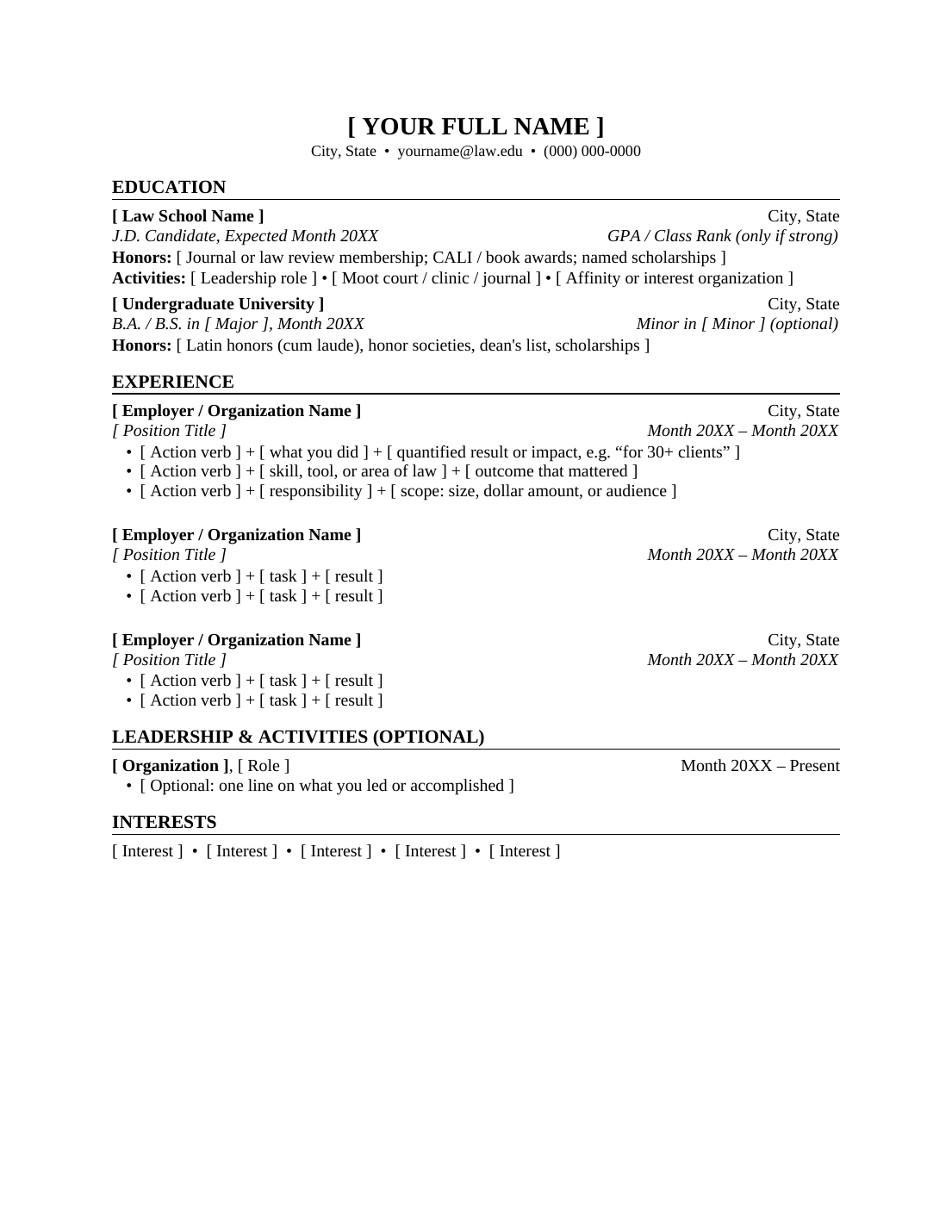
I have laid out that format below and given you a template you can download and fill in. Everything in the example is a placeholder, so you can drop your own details straight in and keep the structure that firms are used to reading.
Editable Microsoft Word document. Opens in Word, Google Docs, or Pages.
Anatomy of the page
Before you touch the content, it helps to see how the page is built. Every section earns its spot, and the order is not random. Here is what goes where, and why.
- 1
Name and contact header
Your name larger and bold at the top, centered. One line under it with city and state, a professional email, and a phone number. No street address, no photo, no objective.
- 2
Education comes first
You are a law student, so law school leads. List the J.D. and your expected graduation, then GPA or class rank only if it helps you, then honors and activities. Undergrad sits below it.
- 3
Experience, most recent first
Employer and location on one line, title and dates italicized beneath, then two to four bullets. Legal and non-legal work both count, especially early on.
- 4
Accomplishment bullets
Start every bullet with a strong verb and quantify the result when you can. Focus on the impact of the work, not the list of duties, and keep your verb tense consistent.
- 5
Leadership and activities
Optional, but it earns its place for journals, moot court, clinics, and student organizations, especially when you held a leadership role.
- 6
Interests
A short, human last line. Two to five specific interests make you memorable and hand the interviewer an easy way to open the conversation.
Advertisement
Formatting rules firms expect
None of these are stylistic preferences. They are the unwritten rules a reader uses to decide, in about six seconds, whether your resume looks like it belongs in the pile. Get them right and the reader never has to think about format at all.
Keep it to one page
For a student or a junior attorney, a second page tells the reader you do not know the norm yet. Cut content before you shrink the font below about 10.5pt.
Conservative serif font
Times New Roman, Garamond, or Century at 10.5 to 12pt. Margins between half an inch and an inch. Black text, nothing else.
Reverse chronological
Most recent first inside every section. Right-align your dates and keep the format identical the whole way down.
Lead with a verb
Open each bullet with an action verb and put a number on it when you can. “Drafted 12 memos” says more than “responsible for memos.”
No pronouns, no objective
Leave out “I” and “my,” drop the objective statement, and skip photos and graphics. Let the content carry it.
Send a PDF
Export to PDF before you send so nothing shifts on someone else’s machine. Name the file FirstLast_Resume.pdf.
Be consistent everywhere
Same bullet style, date format, spacing, and verb tense throughout. The alignment should look like a machine set it.
Handle honors with care
List GPA or class rank only when it helps you. Spell out journal and award names so a reader outside your school understands them.
Strong bullet verbs
The fastest way to make a bullet sound weak is to open it with “responsible for” or “helped with.” Lead with a real verb instead, one that shows you did the thing. Keep this list handy while you write and rotate through it so you are not repeating yourself.
Do and avoid
- Keep it to one page with clean, consistent alignment.
- Tailor your bullets toward the work the employer actually does.
- Quantify impact whenever you honestly can.
- Put law school first and lead with your strongest material.
- Export to PDF and name the file professionally.
- Photos, logos, color, columns, or any fancy graphics.
- An objective statement, or the word “I.”
- Listing duties with no result or scope attached.
- Inconsistent dates, fonts, or bullet styles.
- Stretching to two pages or shrinking the type to cram it in.