The Legal Cover Letter
A cover letter has one job: it tells an employer why you want to work for them, and why they should want you. Legal employers expect a specific, conservative format, so the trick is to hit that format while still sounding like a real person who did their homework.
I have broken the letter down paragraph by paragraph below and given you a template to start from. Keep it to one page, write it in your own words, and tailor every letter to the employer you are sending it to. A reused letter is easy to spot, and it costs you.
Editable Microsoft Word document. Opens in Word, Google Docs, or Pages.
What goes where
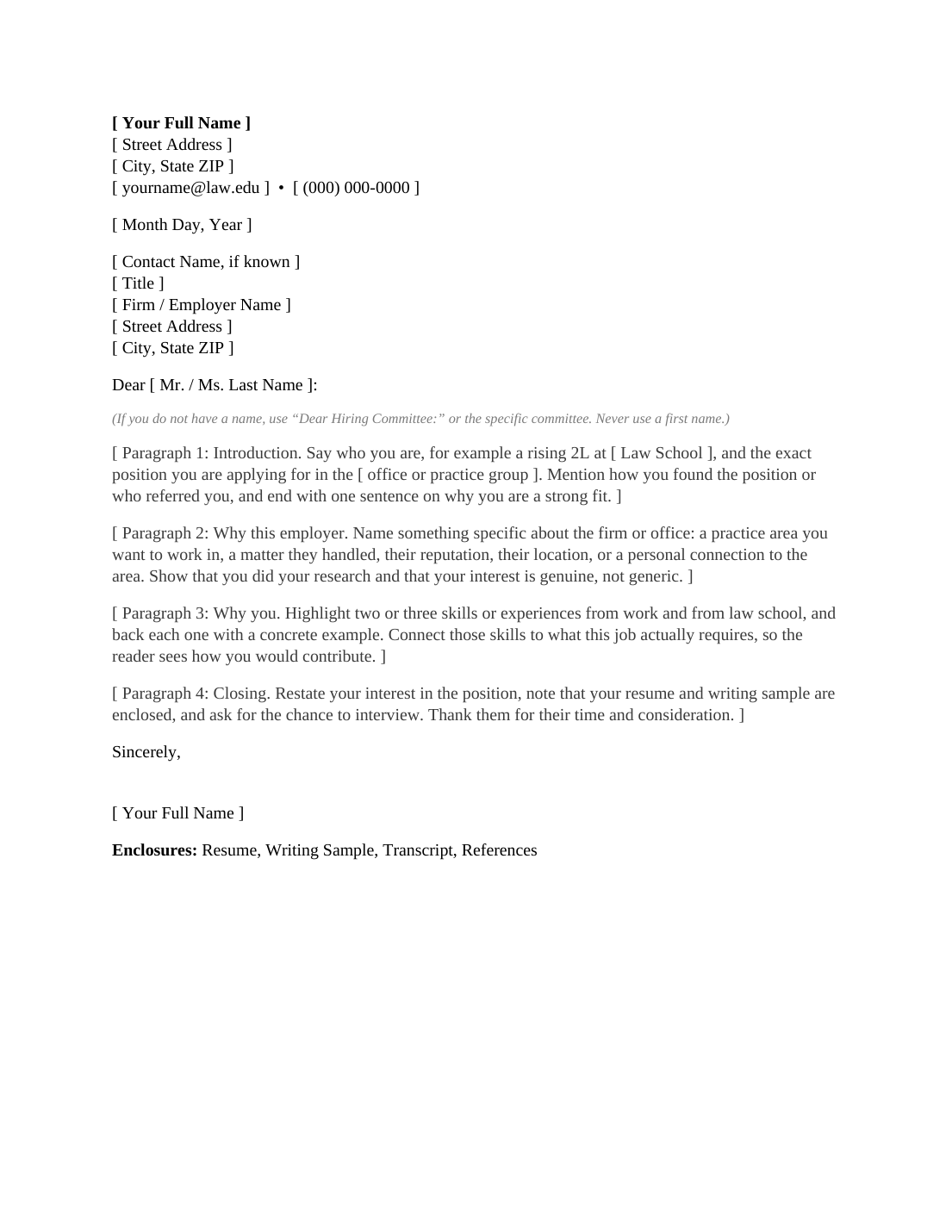
Before the words, get the skeleton right. A legal cover letter follows the same business letter shape every time, and a reader notices instantly when a piece is missing. Here is the layout, top to bottom.
- 1
Heading block
Your name and contact information at the top, then the date, then the employer’s name and address. Match this block to your resume so the two look like one package.
- 2
Salutation
Address a specific person by last name when you can. If you do not have a name, write “Dear Hiring Committee:”. Never use a first name, and never write “To Whom It May Concern.”
- 3
Body, four paragraphs
Introduction, why this employer, why you, and a closing. Each one has a specific job, which the next section breaks down.
- 4
Sign-off
Close with “Sincerely,” leave room for a signature, and type your name. List your enclosures, like your resume and writing sample, on the line below.
The four paragraphs
This is the structure most law school career offices teach. You can split the middle into two paragraphs if you have a lot to say, but four is the standard, and the whole letter still fits on one page. Open each one below to see what it is doing and how to write it.
Open by saying who you are and what you want. State your year and school, for example a rising 2L, and the exact position you are applying for. If someone referred you, or you met an attorney at the firm, name them here, because a name gets attention. Then add one sentence that previews why you are a good fit, so the reader has a reason to keep going.
Tip: Name the specific position and office. A letter that could have been sent to any firm reads like it was.
Advertisement
Formatting rules
These are the conventions employers read for without thinking about it. Follow them and the reader spends their attention on what you wrote, not on what looks off.
One page, three or four paragraphs
Single spaced, with a blank line between paragraphs. It is rare for a student to need more than a page.
Business letter format
Your contact block, the date, and the employer’s inside address. Leaving either one out looks careless.
Use a name when you can
Address a real person by last name. If you cannot find one, address the hiring committee. Never a first name.
Tailor every letter
Write a fresh letter for each employer. Do not copy sample language word for word, because it will not fit you.
Match your resume
Use the same heading, font, and contact block as your resume so the two documents read like one package.
Show, do not tell
Back up every claim about your skills with a specific example from your work or your classes.
Professional and warm
It is fine to let some personality come through in your word choice. Stiff and robotic is not the goal.
Send a PDF
Export to PDF so the formatting cannot shift, and name the file FirstLast_CoverLetter.pdf.
Common mistakes
Almost every weak cover letter fails in one of a handful of predictable ways. Read your draft once just to check for these.
- Sending a generic letter that could go to any employer.
- Naming the wrong firm or contact, usually from reusing an old letter.
- Leaving out the inside address or the date.
- Using a first name in the salutation, or “To Whom It May Concern.”
- Repeating the resume instead of explaining what it shows.
- Running past one page, or filling it with words that add nothing.
- Claiming skills with no example to prove them.